

✍🏾 Hey Y’all: Just Checking In
Observations from the Nonprofit Nomad
Over the last six months on the road as the Nonprofit Nomad, I’ve checked into more hotels than I care to count. When you live and work out of suitcase-friendly spaces, you stop paying attention to extra perks and start looking at pure execution.
I’ve realized I’m not really judging customer service—I’m watching organizational choices.
Personally, I love a solid 2- or 3-star hotel. I don’t need a resort or a fancy spa. I just need a few basic things done exceptionally well:
A clean room. (Non-negotiable).
A lobby with comfortable seating. (Sometimes you just need to work somewhere that isn’t your desk or bed).
Great Wi-Fi. (To stream my shows, play games, and actually get work done).
All-day coffee. (An absurdly simple offering that so many places stumble on).
No pool. (Honestly? Skip the pool. It keeps the hotel quiet, cuts overhead, and keeps the room rate reasonable).
No breakfast—unless there’s bacon. (Don’t serve me lukewarm, rubbery eggs just to say you offer ‘free breakfast’).
Everything else is secondary.
The Nonprofit Reflection: What Are Your “Pools”?
The nonprofit sector has its own version of hotel amenities.
Too many small-to-midsize organizations spend massive amounts of time, money, and emotional energy building “pools”—spinning up a new advisory committee, adding another annual event, launching a flashy public initiative, or trying to maintain an active presence on five different social media platforms.
Meanwhile, back at the desk:
Nobody is answering the main phone line.
Volunteer inquiry emails sit in an inbox for three weeks.
Board packets are sent out 12 hours before the meeting.
Job descriptions haven’t been updated since 2018.
Maintaining a pool is expensive. It takes insurance, routine cleaning, chemical balancing, and staff time to manage complaints when it’s out of order. If your basic operations—your Wi-Fi and clean sheets—aren’t rock solid, that pool isn’t an asset. It’s an expensive distraction.
A Question Worth Carrying:
What is one “pool” your organization is exhausting itself to maintain right now while a core operational basic goes neglected?
Speaking of shiny amenities that distract us from core operational health... let’s talk about AI.
Right now, the sector is hyper-focused on picking the newest, trendiest digital tool (the pool).
But if your organization hasn’t figured out how to support, develop, and retain its people (the clean sheets), no algorithm on earth is going to save your capacity...
AI Isn’t Your Strategy, Investing in Your People Is
Why tech-first solutions create administrative drag, and how to use digital scaffolding where it actually matters: developing your team.
There isn’t a nonprofit in existence today that shouldn’t be paying attention to AI.
It is changing how we work, live, create, process information, and measure our impact. I cannot think of a single nonprofit focus area that isn’t impacted by AI—either directly or indirectly. And the people we serve are certainly living in that reality.
Deciding that we “aren’t going to use it,” or declaring as leaders that it is “too unethical” or “too complicated” isn’t going to change what’s happening around us. In fact, sticking our heads in the sand will only stifle the growth—and dare I say, the relevance—of our sector.
But here is where leaders get trapped: A tech-first approach to any problem is bad strategy.
In the nonprofit world, leading with technology leads straight to mission creep, operational inefficiency, and unsustainable “solutions” that cost far more than they solve. Shiny and new is never a reason to adopt AI.
The Gap: Where is the AI Needs Assessment?
Imagine being a nonprofit leader right now. You’re feeling equal parts pressure and confusion:
How do we use it?
Should we use it?
How do I even discuss this with my team without causing panic?
Typically, when you decide to adopt a new system, you start where every good strategist starts: a needs assessment. You ask: What is the problem? What is the gap? What is the human need?
Yet with AI, conventional wisdom has gone out the window. Leaders are being told to “just start playing with prompts” or pick a software package before they’ve even identified what friction they are trying to remove. Before greenlighting any new tool, workflow, or AI experiment, run it through these five operational checks:
Strategic Alignment: Are employees building competencies the organization actually needs for the future, or just acquiring disconnected technical skills?
Institutionalization: Is this capability a structured organizational habit, or an uncoordinated scramble left entirely up to individual initiative?
Sustainability: If budget cuts hit tomorrow (or your solo Ops person leaves), does employee growth and execution completely grind to a halt?
Oversight & Guidance: Do managers know how to evaluate or guide these requests, or are they just stamping approval on arbitrary $500 conference tickets?
Proprietary Info & Data Risk: Are staff uploading internal reviews or confidential client data into public AI tools to write self-evaluations?
The Strategic Shift: Start with Your Biggest Operational Gap
If you look across your organization—whether you are small, mid-sized, or large—there are always operational gaps.
What we are proposing isn’t that you find a random administrative task for AI to automate. We are proposing using AI as a capability to fill one of the biggest, most neglected gaps in our entire sector: professional development and investing in your employees.
Your people are your strategy. But managers are routinely drowning in administrative drag—leaving zero time to build career pathways, map competencies, or coach their teams.
Instead of using AI to generate more surface-level “content” or write generic board updates, what if you used it to build digital scaffolding for human growth?
Individual PD Plans: Using structured AI templates to draft personalized 90-day learning goals based on individual staff competencies.
Competency Mapping: Offloading the heavy lifting of researching sector standards so managers can spend their time actually coaching, not typing.
Performance Conversations: Utilizing AI to summarize feedback trends and help managers frame constructive, equity-focused performance discussions.
When you use AI to free up human capacity for human investment, AI stops being a distracting “pool” and starts strengthening your core infrastructure.
Walk-Away Takeaway
Stop asking: “Which AI platform should we invest in?”
Start asking: “What administrative load can we lift off our managers so they can spend more time developing our people?”
What’s Really Going On Here?
The $500 Professional Development Fallacy
As COO of a previous organization, I was a solo department handling every operational and HR function in the organization. I was fiercely proud when I managed to carve out $500 per employee in our annual budget specifically for professional development. In our sector, where PD is usually the first line item to get axed during a shortfall, felt like a major win.
Confession time: Even if that funding hadn’t ultimately been cut due to a budget shortfall, it wasn’t strategic, and it wasn’t sustainable.
I had added money to a spreadsheet, but because I was running on empty, I hadn’t designed the system around it:
There was no alignment with strategic organizational priorities.
There was no guidance on what competencies mattered most over the next 3–5 years.
There were zero instructions for managers on how to structure PD conversations, establish equity, or measure accountability.
I simply didn’t have the administrative bandwidth to build a multi-layered talent development program from scratch.
Running It Through the Strategic Readiness Filter
When leaders attempt to fix professional development or jump into AI tools without a strategy, they run into the exact same 5 operational friction points:
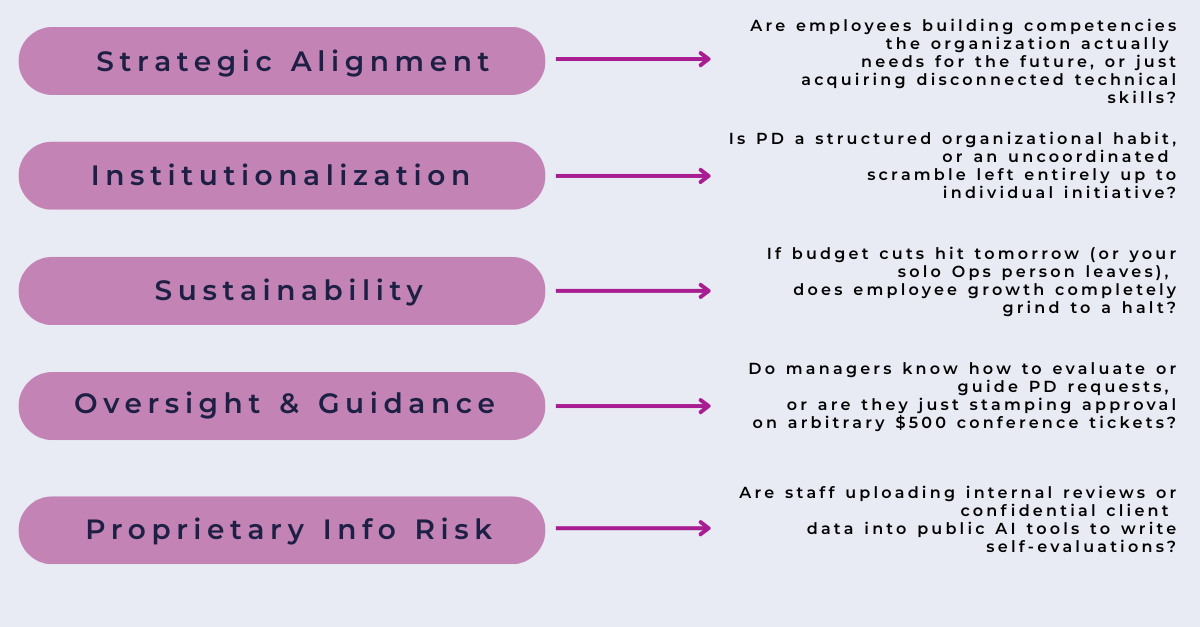
The Root Cause: We treat professional development as a budget-dependent, line-item perk rather than an integrated organizational capability.
KISS: Keep It Strategic, Sweetheart
How AI Acts as Your Digital Scaffolding for Professional Development
Could AI have saved me back when I was that overwhelmed COO? Yes—not by replacing my leadership, but by serving as my administrative assistant to build the framework.
AI allows small and mid-sized nonprofits to shift from Traditional PD (conference-focused, budget-dependent, reactive) to Future-Ready PD (personalized, low-cost, strategy-aligned) without needing a full-time HR department.
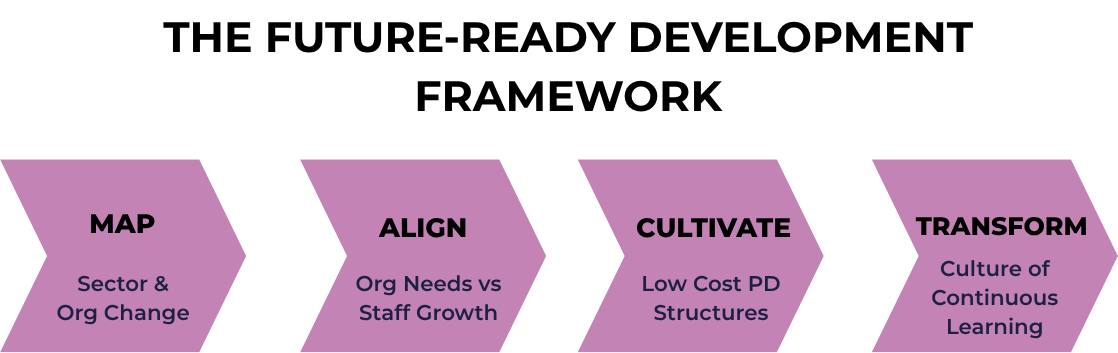
1. Shift from Skills to Behavioral Competencies
Don’t just ask AI for “training ideas.” Use it to define future-ready competencies like responsible AI integration, collaborative leadership, or data-informed decision-making.
Prompt for Leadership: “What key behavioral competencies will an Operations Director in a mid-sized advocacy nonprofit need over the next 3 to 5 years to handle rapid digital transformation?”
2. Build Low-Cost, Actionable Growth Plans
Support doesn’t always require cash. Prompt AI to design 90-day learning plans built around peer mentoring, stretch assignments, learning cohorts, and project-based learning.
Prompt for Managers: “Design an 8-week learning plan for an employee to improve their project management and strategic communication skills. Allocate 1 hour per week using low-cost supports like internal shadowing, peer mentoring, and hands-on application.”
3. Equip Managers to Coach (Not Just Review)
Give managers structured prompts to help employees self-assess their own strengths and identify blind spots before 1-on-1 performance chats.
Prompt for Employees/Managers: “Act as a non-judgmental career coach. Ask me 5 targeted questions, one at a time, to help me evaluate my current level of competence in cross-departmental facilitation and pinpoint specific areas to grow.”
Energy Meter & Strategic Return
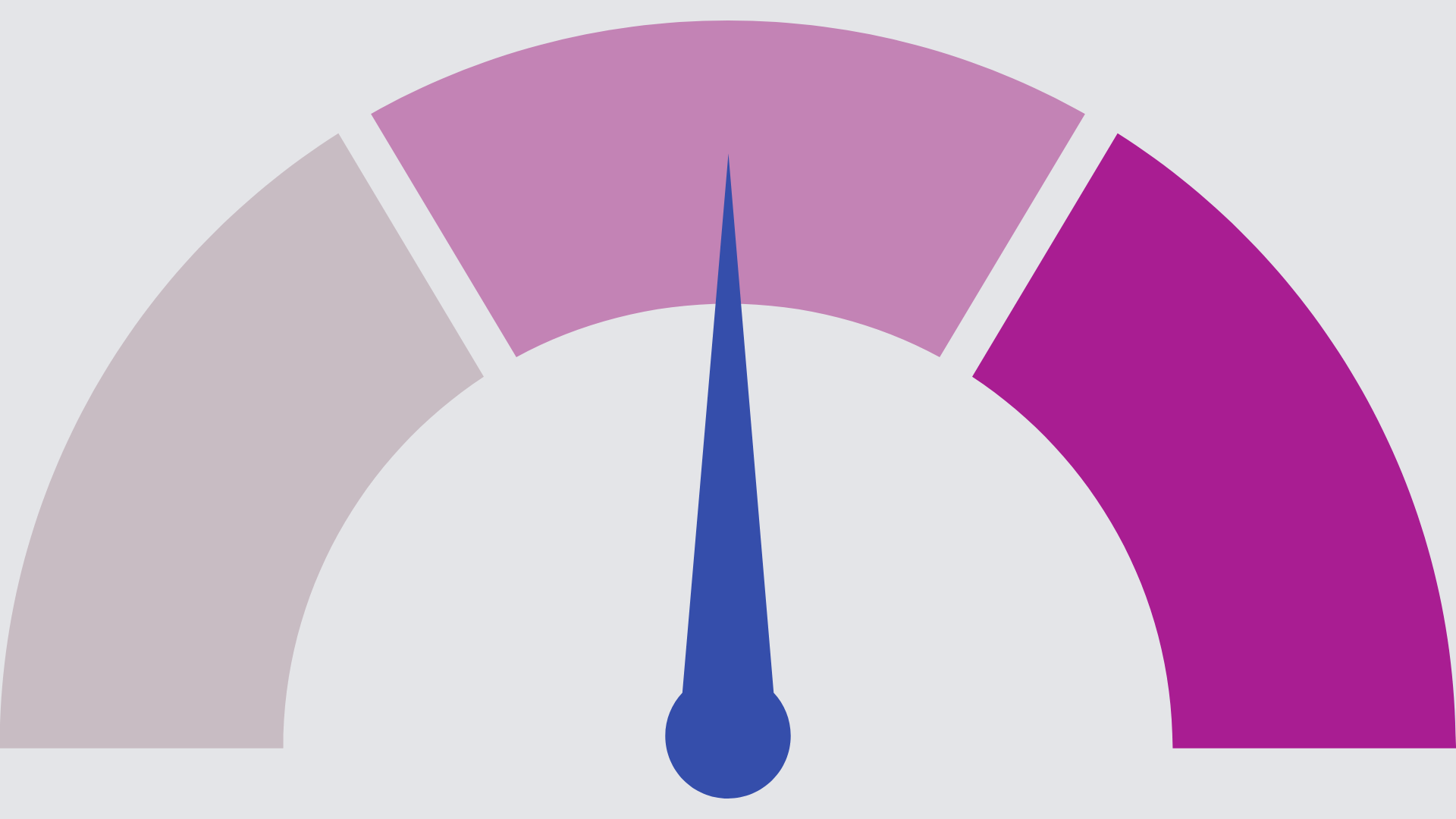
Lift Rating: Medium (Takes 1–2 hours to set up your master prompts and share them with managers)
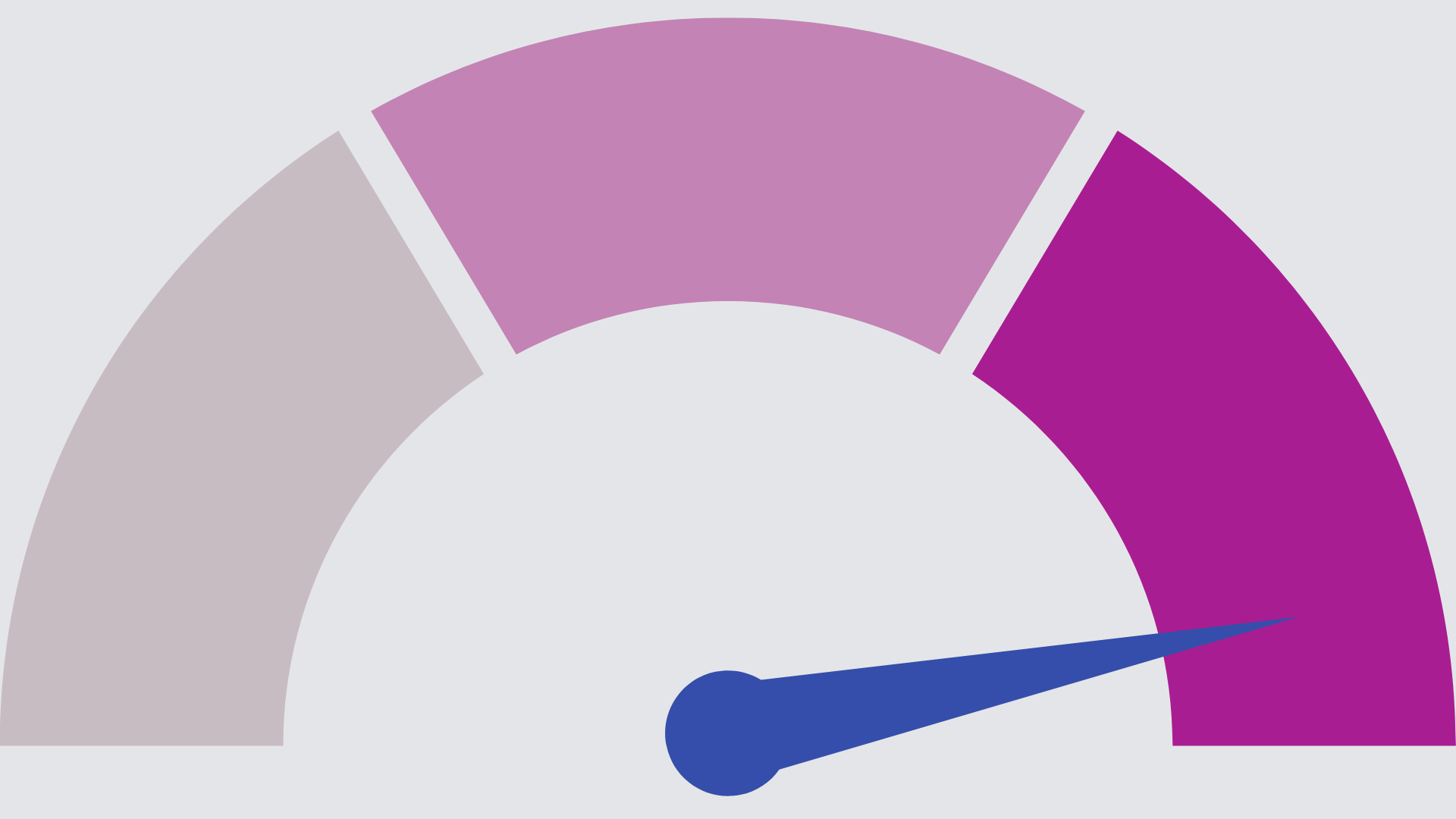
Strategic Return: High (Establishes an equitable, institutionalized talent development system that survives budget cuts and builds future-ready capacity).
Toolkits & Resources
Developed and Handpicked for Strategic Nonprofits
[Free Template] Editable AI 180-Day SOP Template: You don’t need a complex 50-page tech policy that takes six months to draft while your team is drowning. This plug-and-play Google Doc brings shadow workflows into the light, protects your institutional memory, and anchors your operations before the next permanent leader steps onto the stage.
Download the Free Editable AI SOP Template Here (No-nonsense, open-source, and ready to edit today).[Resource Kit] AI Tools for Future-Ready Professional Development: Download the complete slide deck with frameworks, low-cost PD strategies, and copy-and-paste chatbot prompts to share with your leadership team. Download resource kit here.
Podcast Recommendation: Nonprofit Lowdown with Rhea Wong — “AI for Nonprofits: Beyond the Hype.” An insightful listen on how operational leaders are navigating AI and digital transformation without losing their human-centered culture.
Essential Reading: The Tech That Comes Next by Afua Bruce & Amy Sample Ward — A must-read guide on putting technology in its proper place: as a servant to community impact and equity.
What I’m Working On/Out & About
Where the Nonprofit Nomad is Headed Next
Current Stop: The Pacific Northwest! (Exploring Seattle & Portland, catching up on strategy implementations, meeting with leaders on the front lines, and testing waterfront Wi-Fi networks).
Next Up: Scheduling fall client roadstops and transition stabilization efforts.
Workshops & Speaking
I’m stepping back from open public workshops for a short season to focus on custom client work and travel.
However, I still deliver private, practical sessions tailored specifically for boards, leadership cohorts, and staff teams. If you’re looking to get your organization on the same page around practical operations and tech, without the overwhelm. Let’s connect!
I’m also finalizing a fresh set of public sessions coming in late fall/early winter 2026. More details on those soon!
Stay Connected & Keep in Touch
Let’s talk about how an interim leader or fractional executive can anchor your next transition. Want an experienced partner to help conduct an operational diagnostic or stabilize your team through a transition season?
Leave a comment. I would love to hear how your organization handles professional development (or where your “pools” might be hiding!).
Until next time, keep leading with clarity,
—TaKeisha
✍🏾 About the Author
TaKeisha S. Walker is a nonprofit strategist and interim executive who helps mission-driven organizations turn strategy into action and navigate leadership transitions without chaos. As founder of T.S. Walker Strategies and a graduate of the Interim Executive Academy, she specializes in interim leadership, strategic implementation, and functional systems design.
She is the developer of the MACT™ Framework (Mission-Anchored Change & Transition), a practical approach that combines organizational development, change management, and project management to make change less scary and more systemic for small and midsize nonprofits.
TaKeisha works with organizations ready to move from stuck to sustainable—by aligning teams, activating dormant plans, and building infrastructure that drives impact.
Need an experienced partner during your next transition or growth phase?
Let’s talk → twalker@takeishawalker.com