
From Plan to Performance: How One ED Aligned Her Entire Team in 60 Days

✍🏾 Hey Y’all
The biggest shift in your organization might not be a new program; it might be your next staff meeting.
Transformation is a big word and an overused one in the nonprofit sector. It gets tossed around without much thought about what it really looks like in practice. For one organization, “transformative” might mean groundbreaking innovation. For another, it might mean finally doing something others assumed was already in place.
Without getting stuck on the word itself, here’s my point: sometimes transformation doesn’t look like fireworks.
For many organizations, it looks like a Monday morning meeting that finally makes sense.
In this issue, I’m sharing:
A real-world client story about how one ED turned a shelf-bound strategic plan into actual traction without exhausting her people.
A 60-Day Activation Sprint tool you can try in your organization.
A sneak peek at my new nonprofit noir fiction series (yes, you read that right).
If you’ve been wondering how to move from “we have a plan” to “we’re living the plan,” you’re in the right place.
How One Executive Director Activated Her Plan — Without Burning Out Her Team
Structured activation isn’t about doing more, it’s about doing what matters most, together.
When I stepped into this organization, I wasn’t a coach or an outside adviser sending “helpful” emails from afar. I was the transition lead partnering with the ED and staff to make a big vision that none of us created understandable and executable. Sleeves rolled up, I was in the mix, making sure a brand-new executive director had the space and systems to lead.
She had come into the role shortly after the board adopted a “transformative” and ambitious strategic plan. It set an exciting new direction, but there was a catch: the staff was tired, unclear on priorities, and quietly bracing for more “big ideas” without the bandwidth to execute them. Incidentally, exhaustion had been a major factor in the previous ED’s decision to step down.
The Problem
The plan existed. The team existed. But the connection between them was fuzzy at best.
Staff meetings felt like whiplash, jumping from urgent fires to vague “next steps” that weren’t scheduled or anchored to an organizational calendar. Everything needed to be addressed, all the time, by everyone.
Morale was dipping, not because people didn’t believe in the mission, but because they couldn’t see how their work fit into the bigger picture. All they could see was a flood of disparate, time-consuming tasks stacked on top of their “regular” workloads. The new direction seemed to be adding work instead of focusing it.
The Insight
Instead of demanding more output, we doubled down on clarity. I introduced the Strategy Clarity Ladder, a simple but powerful tool to move the team from “What does this mean?” to “I know exactly how my work drives our goals.”
Here’s how we used it:
We turned the plan into plain language. Each strategic goal got a one-sentence “what this means for us” statement, stripped of jargon, so everyone could repeat it in their own words.
We tied roles to results. Every department mapped at least one core task directly to a strategic objective, making the plan something they could see in their daily work, not just in a binder.
The Shift
Over 60 days, three key changes transformed how the team worked:
Created shared definitions of success – Every staff member could articulate what “winning” looked like in their area.
Scheduled time for follow-through – Weekly stand-ups and visible dashboards replaced “we’ll get to it” with “here’s what’s next.”
Named the invisible work – Admin, ops, and cross-team efforts were mapped directly to strategic priorities so they weren’t overlooked.
The Result
By the end of the 60 days, staff could connect their daily work to at least one strategic objective. Morale rebounded, and the board could see in dashboards and updates tangible progress toward the plan.
Walk-Away Tool: The 60-Day Activation Sprint
Yes, this borrows from project management best practices, but believe me, it works.
Focus on 1–2 strategic goals for 60 days and create:
Weekly visibility – Use dashboards, check-ins, or shared trackers. Don’t burden your team with building a fancy, coded dashboard when a spreadsheet or simple but focused check-in will suffice. Start small and focus on impactful change.
Daily “hand-raise moments” – Encourage quick asks for help, and name roadblocks out loud. Check-in meetings should center on the aspects of the plan that are most vulnerable or in red. For those of us working in social impact, this approach will feel familiar; it’s a form of triage for your strategy.
End-of-sprint review – Celebrate wins, capture lessons learned, and reset for the next sprint. This isn’t just about reflection; it’s about reinforcing that progress is possible, building momentum for the next cycle, and normalizing a culture where adaptation is expected, not feared.
Most strategic plans stall because people don’t know how to translate vision into daily action. The Strategy Clarity Ladder bridges that gap.
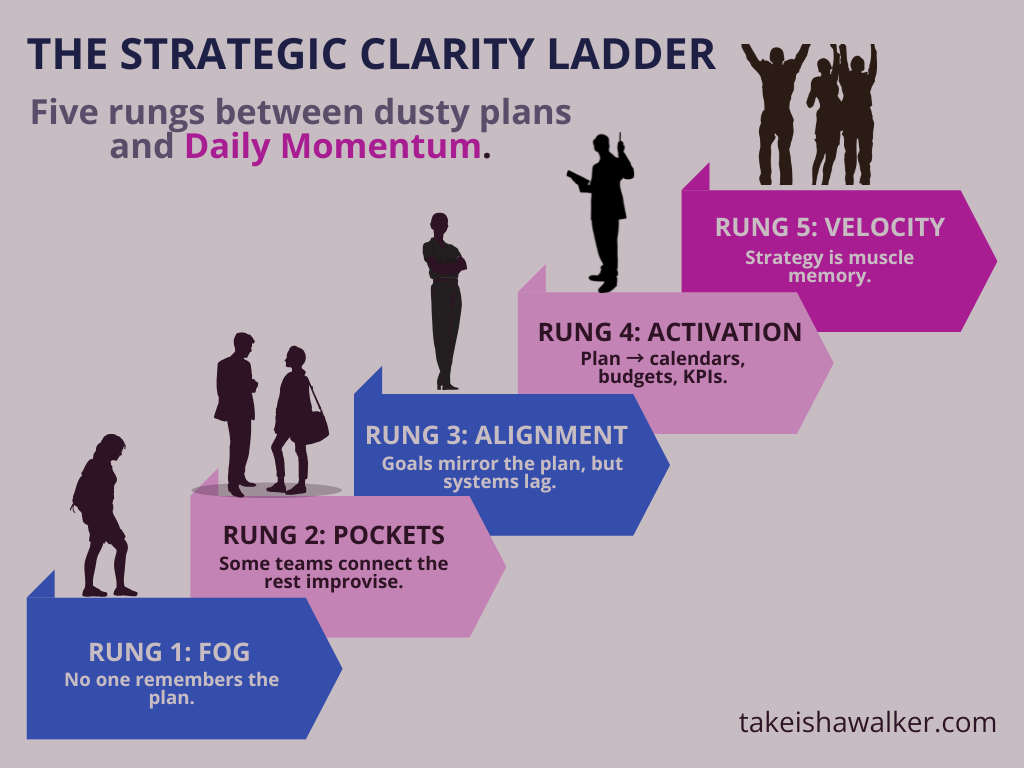
When people can “climb” this ladder, they stop wondering what the plan means and start owning their part in it.
Subscriber Exclusive-the Debut of Nonprofit Noir
In Nonprofit Noir: The Founder’s Fall, interim executive Kassandra Hollingsworth walks into her latest assignment expecting spreadsheets and strategy. Horizon Community Impact, a small but mighty nonprofit, has landed an $18 million federal grant and needs her steady hand to “catch up with the money.”
But vague explanations, an evasive executive director, and a board chair obsessed with “discreet” actions suggest something darker beneath the surface. Then, on the night of a gala meant to celebrate success, the organization’s beloved founder, Lionel, is found dead in the sculpture garden.
As grief ripples through the community, Kassandra suspects foul play within the very organization she’s meant to stabilize. Every ally could be an enemy, every conversation a trap—and someone is watching her every move. To save Horizon, and herself, she must unmask the truth before the next casualty falls.
Be one of the first to read Part I: What We Walk Into.
“What’s Really Going On Here?”: A Follow-Up
In my last issue, I talked about “strategic silence” when staff can’t see themselves in the strategic plan. Apparently, that hit a nerve. My inbox filled with notes from nonprofit professionals who weren’t part of the planning process but want to understand the plan and where they fit.
The question many asked boiled down to this:
“If I wasn’t involved in creating the plan, how do I understand it and my role in it? How do I ask for clarity, without overstepping?”
Here’s the short answer: you don’t need to wait for an invitation. If you’re committed to the mission, asking for clarity isn’t overstepping, it’s activating.
And as you saw in Article 1, when a new ED paired clarity with structure, she not only activated her plan but rebuilt team morale in just 60 days. That kind of alignment starts with conversations like the ones below.
If You’re Staff:
Ask your supervisor or ED:
“What’s one part of the strategy that touches my work?”
“Where should I be leaning in right now?”
Then, suggest a conversation or meeting where your team maps its work to the plan. Often, leadership doesn’t realize how much translation is needed until someone asks.
If You’re a Leader:
Your job is to make the plan visible and relevant. Try:
Plan-to-Work Sessions – Invite teams to connect organizational goals to their own priorities. Make it a lunch-and-learn with flip charts or virtual whiteboards.
Map Dependencies – Show how Ops, HR, Finance, IT, and Programs directly support strategic outcomes. These areas are often taken for granted, believe me, they’ll appreciate the attention.
Assign a Translator – Someone whose job is to keep the plan alive in plain language for their team. Give this role prominence; a regular speaking slot during staff meetings, perhaps.
The Bottom Line
Strategy without translation is just theater. When people can see the map and their dot on it, they move with confidence.
Use my Strategic Activation Checklist to spot where strategy meets friction and identify your next move.
Keep leading with clarity,
— TaKeisha
P.S.
If you need help moving your plan from paper to progress, I can help your team get unstuck. Let’s talk it through, no slides, no sales pitch, just a conversation about where you are and where you want to go. Book a quick consult
✍🏾About the Author
TaKeisha S. Walker is a nonprofit strategist, interim executive, and founder of T.S. Walker Strategies. She helps mission-driven organizations move from stuck to sustainable by aligning teams, activating dormant plans, and building the infrastructure that supports real impact.
With more than 20 years of experience and a background in operations, leadership transitions, and strategic implementation, she specializes in turning strategy into action and navigating change without the chaos.
She’s also a proud graduate of the Interim Executive Academy and the creator of the No NonSense Nonprofit, a newsletter and resource hub for nonprofit leaders who are done spinning and ready to build.
📨 Need a no-nonsense partner during your next transition or growth phase?
Let’s talk → twalker@takeishawalker.com
The Strategic Clarity Ladder is such a useful framework. Most organizations I work with find themselves somewhere between pockets and alignment. There is some progress, but systems lag behind. The reminder I take from this: strategy isn’t just about having a plan, it’s about building the habits and systems that make clarity stick every day. I also loved the first installment of Nonprofit Noir.